


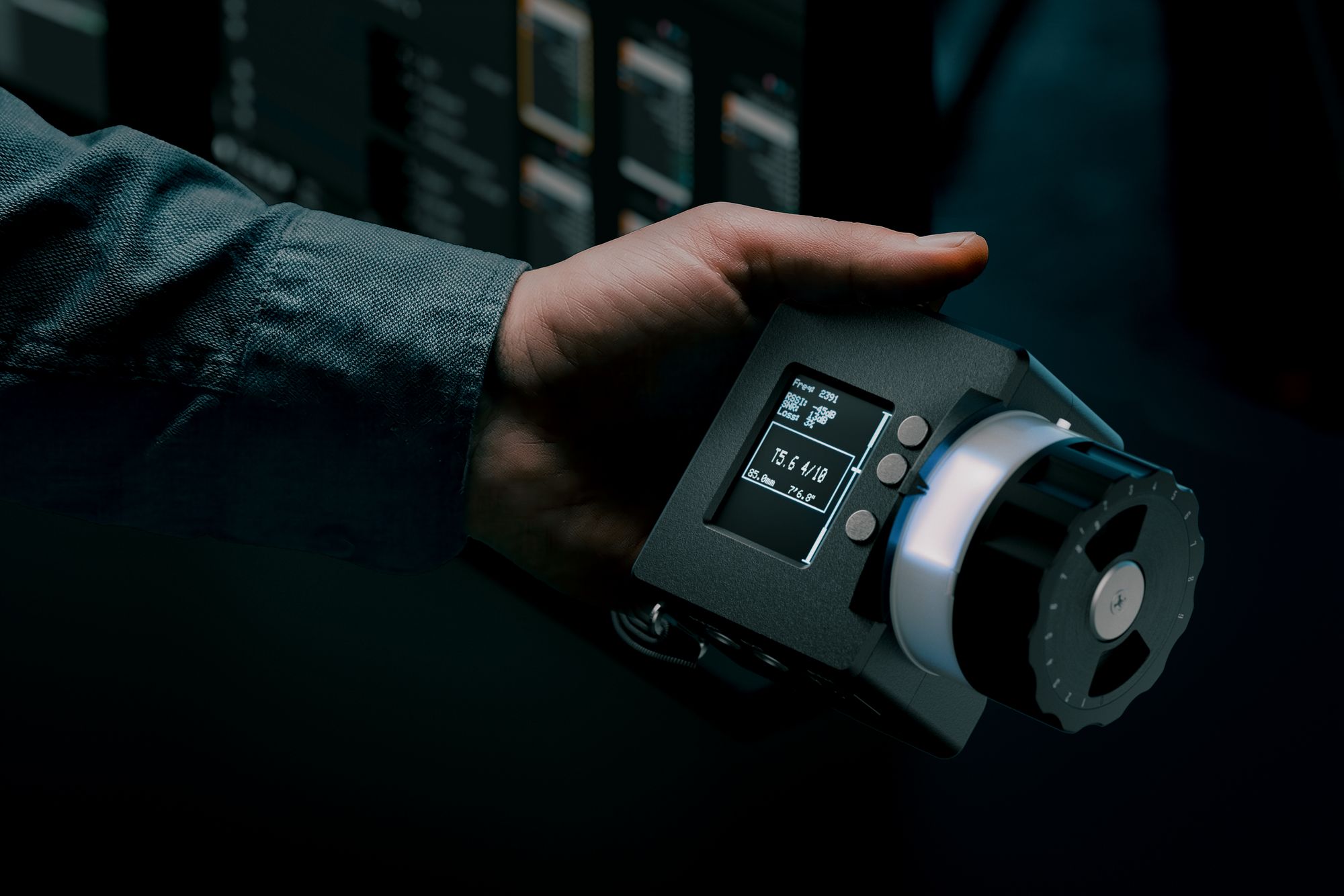
LONDON, UK [6 February 2026] – Digital Camera Systems (DCS) today announced Lens Link, a new handset designed to extend lens control range on set while keeping crews on the lens control systems and workflows they already trust.
Lens Link is built for modern set realities, where the DIT and DoP may be positioned at a video village or remote operating positions, and where 1st ACs may need dependable control during large crane moves, cameras on vehicles, stadium work, or safety-driven standoffs. Rather than replacing an existing lens control setup, Lens Link is designed to extend it.
Designed for long range, without replacing what crews already use
Lens Link doesn’t replace existing systems or add lens motors on a camera. Instead, it works alongside a Preston system (ARRI LCS and Tilta compatibility coming soon) that is already driving motors, extending usable control range without changing the way crews prefer to work day to day. Built with extreme flexibility in mind, Lens Links is rugged and durable, ideal for DITs, ACs, and DoPs who need reliable control when distance becomes a constraint.
How DCS Lens Link works
Lens Link is a two-part hardware setup consisting of the Lens Link handset and an on-camera receiver (DCS Bridge or LDT-V2). The receiver connects to a compatible Preston MDR for motor control.
Lens Link supports two operational modes, depending on how a production wants to balance speed, robustness, and distance.
True Wireless mode runs directly between the Lens Link handset and the on-camera DCS Bridge. Operating on dedicated sub-WiFi frequencies (2,200-2,500MHz), it’s designed to deliver stable, low-latency transmission even in congested RF environments. In ideal, line-of-sight conditions, the Lens Link has a wireless range up to 2KM.
Remote mode is designed for maximum robustness and is Lens Link’s primary long-range workflow. In this mode, the Lens Link handset connects via Ethernet to the LDT-RX1 Network Bridge positioned closer to the camera, and the RX1 then communicates wirelessly with the on-camera receiver (DCS Bridge or LDT-V2). This keeps the wireless link near camera short and robust, while overall distance is extended over the Ethernet (or fibre) network run.
“On large sets, range is the thing that breaks the workflow. Crews already have lens control systems they trust, so Lens Link was designed to extend that control for long-range setups, without changing how people work day to day,” said Gary Keller, General Manager at DCS.
“The Lens Link has been a game changer on set, especially because it can pair with standard networking equipment. It gives us flexible configurations and reliable range in environments that would normally be impossible. On a recent job in an old military bunker, heavy RF interference and thick concrete and steel made controlling iris from outside unfeasible. By running the RX1 inside over Ethernet, we had full, reliable control without issue. It’s an essential piece of kit for demanding productions,” said Mardon Decarvalho, DIT. Mardon has worked as a DIT for over 13 years. His credits include productions for Marvel, Paramount, Netflix, and Universal, with recent work including Deadpool and Wolverine and Now You See Me: Now You Don’t.
“I used Lens Link while shooting in Kenya and Morocco. In extreme conditions, from wet jungle to scorching desert, it handled busy multi-camera days. Using the RX1 over Ethernet, I extended the distance between the video village and set by over 100 metres, and could perform iris pulls as if I was standing right next to the camera. A great tool that really stood out on this job,” said Anton Badstuber, DIT. Anton has worked as a DIT for six years. His most recent feature credit is The Amateur.
Lens Link has logged over 200 days of on-set testing, including use on productions for major studios such as HBO, Paramount, and Amazon MGM Studios.
Key features
- True Wireless Mode range up to 2KM in ideal, clear line-of-sight-conditions
- Remote Mode range unlimited over ethernet and fibre networks, using ~100M wireless hop to camera via DCS LDT-RX1
- Designed for stable, low-latency control in congested RF environments (2,200-2,500MHz)
- Display with live lens data readout (Focus, Iris, Zoom)
- Mechanical precision with custom mapping of Focus, Iris, or Zoom
- Custom in/out mapping points and ranges, plus unified lens table mapping
- Works with Preston lens control systems, with ARRI LCS and Tilta compatibility coming soon
Compatibility and specifications
Lens Link is compatible with Preston MDR3, MDR4, and MDR5, and works with a DCS Bridge or LDT-V2. The handset weighs 500g and measures 110 × 55 × 90mm.
Pricing, availability, and demos
A full Lens Link package, including Lens Link, Bridge, LDT-RX1, and required cables and accessories, is priced at £6,000 +VAT. Lens Link will be available from today to purchase directly from DCS, and available for rental via CineArk. DCS will be offering introductory pricing with a 25% discount on the first 25 units sold.
DCS will be demonstrating Lens Link at BSC Expo 2026 at Battersea Evolution in London on 13-14 February 2026, with a VIP and invited guests session on 12 February 2026. Demos will be available at the DCS stand, booth number 142. To schedule a demo, contact info@dcs.film