





Most productions don’t think about range until they hit it. Lens control systems like Preston are trusted, precise, and already part of how crews work. Nobody wants to relearn a workflow mid-production. But those systems were built around a certain assumption: that focus, iris, and zoom control would happen close to the camera. As sets get bigger, more remote, and more safety-conscious, that assumption breaks more often than it holds.
Why this keeps happening
A few patterns show up again and again across productions:
Crane and vehicle work. As a camera swings further out on a crane arm, or rides on a moving vehicle, usable control range often can’t keep pace with the shot.
Remote and safety-driven positions. Stunts, pyrotechnics, and hazardous environments push crews away from cameras by necessity, not preference.
Video village distance. On larger stages and locations, video villages are rarely close to camera. The further it moves, the more likely a standard wireless link starts to struggle.
RF-hostile environments. Concrete, steel, and congested wireless spectrum on a busy set can all interfere with control signals, even at distances that would normally be fine.
None of these are edge cases. They’re just what happens on a big enough set, often enough.
Why the usual fix isn’t a fix
The instinctive response to a range problem is to either move people closer to the camera or swap out the lens control system entirely for something built to handle distance differently. Neither is simple. Moving closer isn’t always possible, and a full system swap means new kit, new training, and new risk on a live production.
DITs are usually the ones who feel this first. They’re the ones managing where video village sits relative to camera, dealing with RF interference on a congested set, and fielding the call when a crane move or a stunt setup puts control further away than the kit was built to handle. What they need isn’t a different system to learn. It’s more range out of the Preston-based setup they already run and trust.
Extending control, not replacing it
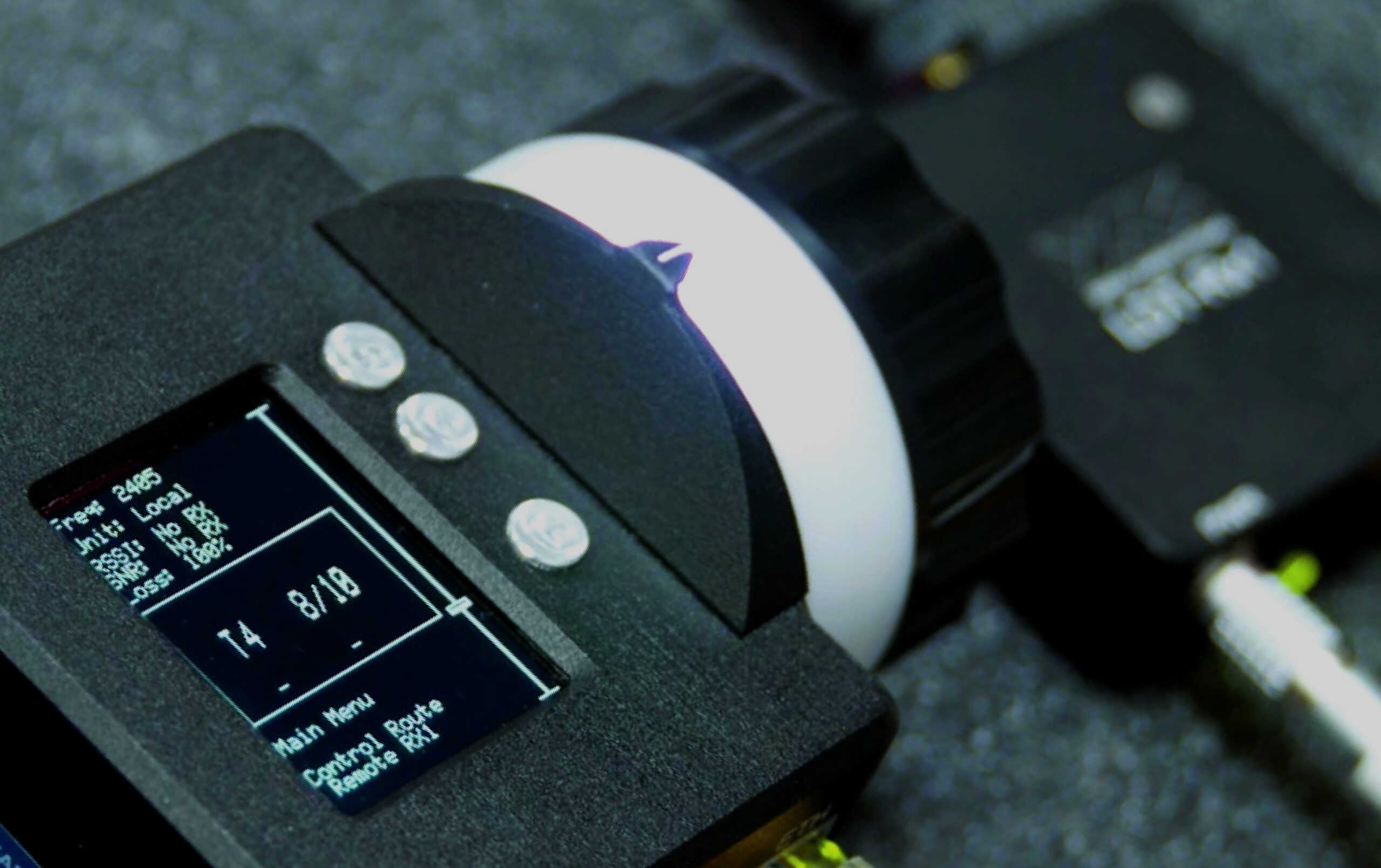
This is the problem Lens Link was built to solve. It’s a dedicated, compact handset, built around controlling iris at range, which is exactly why it’s become a DIT tool for exactly these situations. It doesn’t add lens motors to the camera or replace what’s already driving them. It works alongside a Preston system via a small receiver, a DCS Bridge or LDT-V2.
In practice, that means two ways of extending range depending on what a set needs. True Wireless mode runs directly between the Lens Link handset and the on-camera receiver, operating on dedicated sub-WiFi frequencies (2,200 to 2,500MHz) for stable, low-latency control even in congested RF environments, up to 2km in clear, line-of-sight conditions. Remote mode connects the Lens Link, via Ethernet, to an LDT-RX1 positioned closer to the camera, which then talks wirelessly to the on-camera receiver over a final hop of around 100 metres. The distance covered by the Ethernet or fibre run is effectively unlimited, only that last short wireless hop needs to stay reliable.
DITs already using it have run full iris control from inside old military bunkers where RF simply doesn’t travel, and extended video village distance by over 100 metres on multi-camera international shoots.
The bigger point
Range isn’t a niche problem that only affects a handful of specialist shoots. It’s a structural weak point in how lens control works on any set that’s bigger, more remote, or more safety-conscious than a controlled studio stage, which describes a growing share of modern production. Solving it doesn’t mean rebuilding the lens control pipeline. It means giving DITs more reach out of the system already in place.
Want to see how Lens Link extends your existing setup on your next production? Get in touch or reach out to schedule a demo.